
The Architecture, Engineering, and Construction (AEC) industry is experiencing a significant change in 2026 with the growing pressure on tight schedules of projects, the upsurge of labor expenses, and the demand of digital accuracy. The core of this change is the outsourcing of BIM modeling, a model that enables a company to tap into specialized expertise, ramp up resources in a short period, and produce high-quality projects without necessarily overloading the internal team. What was regarded as an optional support service has today been turned into a standard operational model of most design and construction companies.
As projects grow more complex and BIM standards become stricter, outsourcing is no longer about cost savings alone. It is now about efficiency, precision, and staying competitive. By outsourcing BIM modeling strategically, companies can stay focused on core design and client engagement, while experienced partners handle the demanding modeling and documentation tasks. To dive deeper, explore our coordination services, advanced modeling solutions, or complete BIM consulting offerings.
The Growing Demand for BIM in Modern Construction
The modern construction workflow has been made to rely on BIM. Governments, developers, and individual clients are also demanding BIM deliverables as a way of maintaining coordination, sustainability, and lifecycle efficiency. By 2026, BIM is not restricted only to large-scale infrastructural projects: it will be commonly used in residential, commercial, and industrial areas.
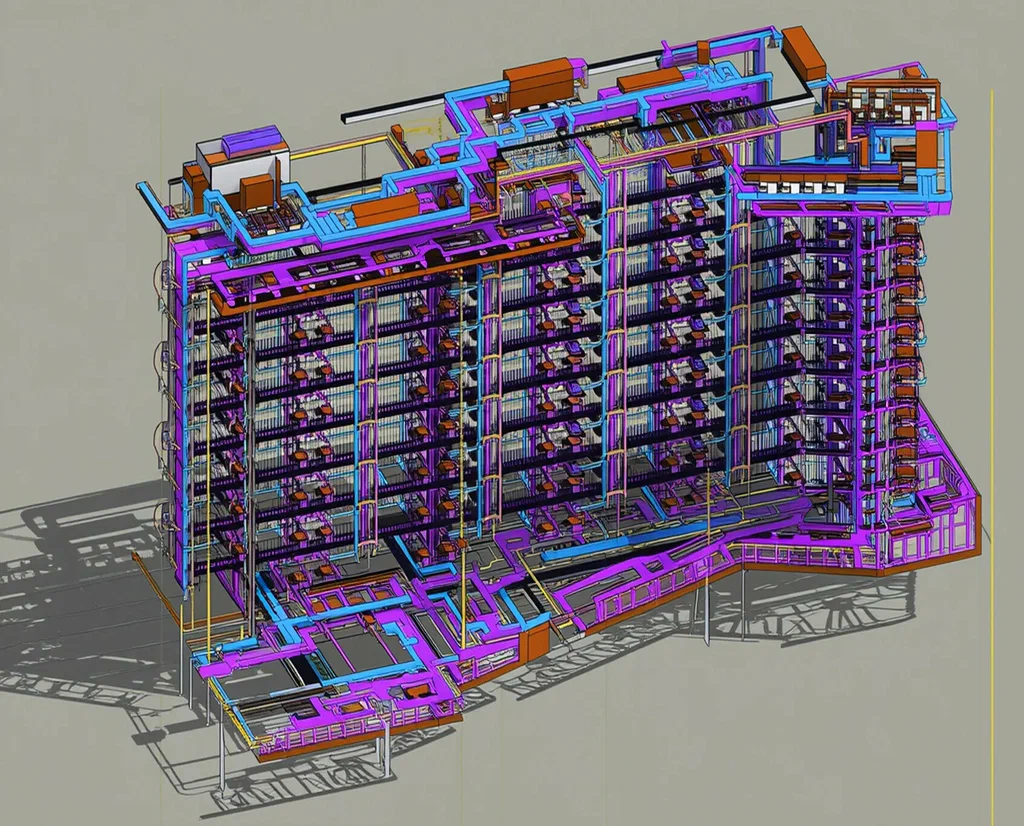
Increased Demand for Skilled BIM Professionals.
This rampant use has resulted in a high demand of skilled BIM professionals. Nevertheless, in order to match the varying workload that varies, many companies are finding it hard to hire and retain the necessary number of in-house professionals. Outsourcing closes this divide by making trained BIM personnel available who can offer uniform output without the indirect costs of permanent employment.
Cloud Collaboration Allowing Outsourcing to flow smoothly.
Moreover, the developer of cloud collaboration systems has improved such that outsourced teams can collaborate effectively with in-house employees. Geographic distance has been virtually destroyed by sharing models in real-time, controlling versions and having remote coordination meetings.
Cost Efficiency Without Compromising Quality
Cost efficiency is considered to be one of the major forces that have led to the outsourcing boom. The cost of having an internal BIM department is high in terms of salaries, training, software licenses, and hardware infrastructure. These expenses can be challenging to justify throughout the year, particularly when it comes to small to mid-sized practices that most firms are dealing with.
- Converts fixed operational expenses into flexible, project-based costs
- Allows companies to scale resources up or down based on project demands
- Helps avoid the financial burden of idle staff during slow periods
- Maintains high-quality standards through specialized workflows and QA processes
- Provides access to experienced BIM professionals without long-term staffing commitments
- Positions outsourcing providers as strategic partners, not just service vendors
- Delivers advanced services like detailed modeling, clash detection, and documentation
- Ensures outputs meet international BIM standards
Access to Specialized Expertise and Technology
BIM technology continues its dynamic development, now enhanced by AI-driven automation, generative design tools, and advanced simulations. To keep pace, companies must invest continually in training and innovation. Outsourcing partners, who work exclusively on BIM services, stay ahead of these technological shifts. Their expertise allows businesses to access the latest tools and trained professionals without heavy in-house upskilling.
This specialized experience becomes even more valuable in complex projects that involve parametric façades, detailed MEP coordination, or digital twin development. Such outsourced teams bring focused expertise that improves project outcomes and reduces technology-related risks. For deeper insights, explore our guides on BIM workflows, review case studies, understand common challenges, or learn how to hire the right BIM partner.
Faster Project Delivery and Scalability
Speed is an important competitive issue in the AEC industry. Clients want shorter schedules that are not accompanied by compromised quality or accuracy. BIM modeling outsourcing allows companies to deliver its projects faster by sharing the workloads on a specific set of external teams.
Since outsourcing vendors have scalable staffing arrangements, they are able to mobilize more resources within short periods of time when a project is at its peak. This flexibility avoids any bottlenecks and makes sure that deadlines are met even when schedules are very tight.
Time zone differences could also help to build near-continuous production cycles. When in-house teams are busy with their workday, outsourced teams are able to carry on with the modeling, which has the effect of minimizing the turnaround times.
Improved Focus on Core Business Functions
By outsourcing BIM modeling, the firms are able to focus their efforts on the core of their competitive strength in their activities. Internal teams will have the opportunity to focus on strategic planning, relationships with clients, and development of creative design as opposed to using a lot of time and resources to produce intensive models. This transformation enhances the general efficiency and assists organizations to provide more valuable services as well as ensure high project performance.
Focus on Design Excellence
Through the outsourcing of modeling tasks, architects and engineers would have greater time to be creative, to conceptual design, and problem-solving. This will result in better design deliverables and considerate project implementation.
Stronger Client Engagement
Shedding the excessive production loads, the teams will be able to devote more time and energy to communicating and collaborating with the clients. Increased interaction increases confidence, accelerates decision-making, and increases customer satisfaction.
Streamlined Operations
Outsourcing has the advantage of minimizing the administrative overhead of recruiting, training, and maintaining huge in-house BIM departments. Companies are able to be lean and at the same time, enjoy sophisticated technical features on demand.
Increased Strategic Productivity.
Through the focus on the top-level project management and business development projects, the companies can enhance profitability and long-term competitiveness. The process of outsourcing is now used as a means of more intelligent resource distribution and not merely as a method of cost-cutting.
Enhanced Collaboration and Global Connectivity
The rise of cloud-based BIM platforms has transformed how teams collaborate across borders. In 2026, distributed project teams are the norm rather than the exception. Outsourcing fits naturally into this global ecosystem.
Advanced collaboration tools allow real-time model sharing, issue tracking, and communication between internal and external stakeholders. Clear protocols and standardized workflows ensure that outsourced contributions integrate seamlessly with in-house efforts.
This global connectivity also fosters knowledge exchange. Firms benefit from diverse perspectives and international best practices, enriching their approach to design and construction.
Quality Assurance and Risk Management
Concerns about quality and control once limited outsourcing adoption. However, modern outsourcing providers emphasize rigorous quality assurance processes. Structured review cycles, automated model checks, and compliance with international BIM standards help maintain consistency and accuracy.
Many providers implement dedicated quality control teams that audit models before delivery. These safeguards reduce errors and improve reliability, ultimately lowering project risks.
Additionally, outsourcing agreements often include service-level commitments and confidentiality protections, ensuring accountability and data security.
The Future of BIM Outsourcing Beyond 2026
As the AEC industry continues to evolve, BIM outsourcing is expected to play an even more strategic role in how projects are delivered. Rapid advances in digital construction technologies, combined with increasing project complexity, are pushing firms to seek flexible and specialized external partnerships. Rather than serving as short-term support, outsourcing is becoming a long-term strategy that helps companies stay competitive in a fast-changing market.
Strategic Long-Term Partnerships
Outsourcing relationships are shifting from transactional arrangements to long-term collaborations. Firms are building stable partnerships with BIM providers who function as extensions of their internal teams.
Integration with Emerging Technologies
Future outsourcing services will increasingly incorporate AI, digital twins, and advanced automation. These technologies will enhance modeling accuracy and enable smarter project insights.
Greater Global Collaboration
Cross-border teamwork will continue to expand as cloud platforms improve connectivity. Global outsourcing networks will support around-the-clock productivity and knowledge sharing.
Scalable Growth Opportunities
BIM outsourcing will enable firms to pursue larger and more complex projects without expanding permanent staff. This scalability supports sustainable business growth and operational flexibility.
Conclusion
Outsourcing BIM modeling has become a powerful strategy for AEC firms seeking efficiency, scalability, and competitive advantage in 2026. By combining cost flexibility, specialized expertise, and advanced collaboration tools, outsourcing enables companies to deliver high-quality projects while focusing on their core strengths.
As the construction industry continues to digitize, firms that embrace strategic BIM outsourcing will be better positioned to adapt, innovate, and thrive in an increasingly complex market.