Key takeaways
- Lap splices are the most common and least expensive method, but they need generous development length and get congested in heavily reinforced sections.
- Mechanical splices (couplers) save space and are required where bar congestion, large bar sizes (#14, #18), or code restrictions rule out lapping at a moderate cost premium.
- Welded splices offer a compact, high-strength connection but require certified welders, weldable-grade steel, and strict quality control.
- Per ACI 318-19, mechanical and welded splices must develop at least 125% of the bar’s specified yield strength (Type 1) to qualify as a full-strength splice; this single number drives most specification decisions.
Rebar rarely comes in one continuous length long enough to run the full height of a column or the full span of a slab. Standard stock lengths (usually 40 or 60 feet), congested reinforcement zones, and phased construction joints all mean bars have to be connected somewhere and how that connection is made has real consequences for cost, schedule, and structural performance.
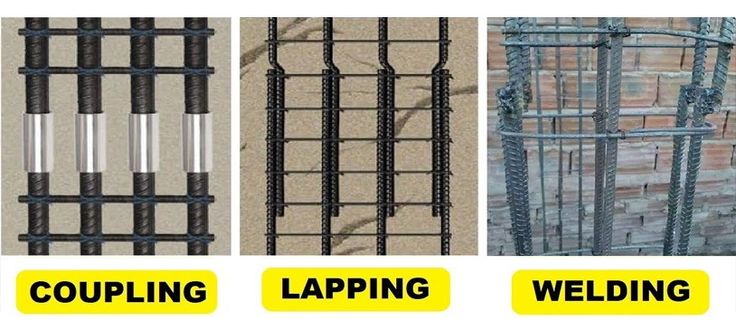
There are three accepted ways to splice reinforcing steel: lap splicing, mechanical splicing, and welded splicing. Each is governed by ACI 318 and has a specific place depending on bar size, congestion, load path, and project budget. This guide breaks down how each method works, where it’s required or restricted, and how to decide which one belongs on your next set of shop drawings.
Why Splicing Method Matters
Getting splice selection wrong doesn’t just cost money; it can create real structural and constructability problems:
- Congestion. Lap splices essentially double the steel in a given cross-section for the length of the lap, which can make it physically impossible to place concrete cleanly in tight sections like mega-columns or beam-column joints.
- Bar size limits. ACI 318-19 (Section 25.5.1.1) doesn’t permit lap splices for bars larger than #11, so #14 and #18 bars require mechanical or welded connections by default.
- Strength requirements. A poorly specified or poorly installed splice becomes the weak point of the entire reinforcement line, regardless of how well the rest of the bar performs.
- Schedule impact. Lap splices are fast to place but eat into concrete cover and clearance. Mechanical splices take more prep and inspection time but reduce steel congestion and rework risk.
Lap Splicing
A lap splice overlaps two bars along a defined length so that stress transfers from one bar to the other through the surrounding concrete’s bond strength, not through a direct mechanical connection between the bars themselves.
How it works:
Bars are overlapped by a calculated “lap length,” which depends on bar size, grade, concrete strength, spacing, and cover. ACI 318-19 recognizes two lap splice classes in tension: Class A (1.0 × development length) and Class B (1.3 × development length), with Class B required in most conditions unless specific stagger and stress criteria are met. Contact splices, where the bars physically touch and are wire-tied together, are preferred over non-contact laps because they resist displacement better during the concrete pour.
Advantages:
- Lowest material and labor cost of the three methods
- No special tools, certifications, or inspection equipment required
- Fast and straightforward for field crews already used to standard rebar placement
Limitations:
- Not permitted for bars larger than #11 per ACI 318-19
- Requires significant added length, which increases congestion in tight sections
- Lap length increases with bar size and grade, which can make high-strength reinforcement (Grade 75+) impractical to lap in constrained spaces
- Sensitive to placement accuracy laps that are too short or poorly staggered are a common source of structural deficiencies
Best fit: Standard slabs, walls, footings, and moderately reinforced columns where space isn’t tightly constrained and bar sizes stay at #11 or below.
Mechanical Splicing (Couplers)
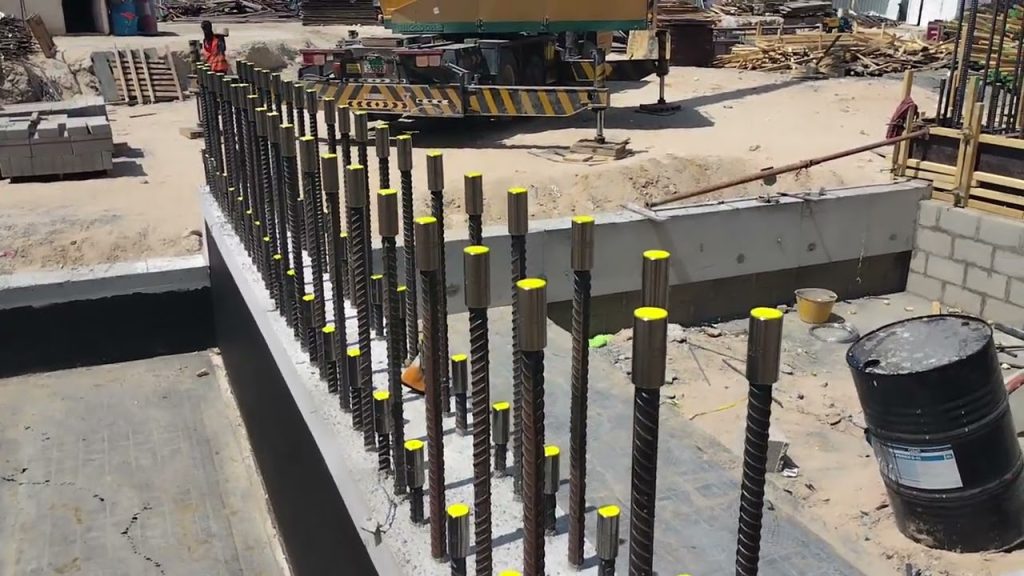
A mechanical splice joins two bar ends using a manufactured coupling device, such as threaded couplers, swaged sleeves, or lock-shear couplers, rather than relying on a concrete bond over a lapped length.
How it works:
ACI 318-19 (Section 25.5.7) defines two coupler types. Type 1 couplers must develop at least 125% of the bar’s specified yield strength in tension or compression. Type 2 couplers must meet that same 125% requirement and also satisfy additional strength and elongation criteria, making them suitable for use in any location, including regions of high seismic demand where full-strength splices are required.
Advantages:
- Eliminates the extra length and congestion that lap splices require
- Required (and often the only practical option) for bar sizes larger than #11
- Cost premium overlapping shrinks or disappears as bar size increases; studies have found the added cost of couplers can be roughly 11% more than lapping for #5 bars but far less proportionally significant for #10 bars, since larger bars need dramatically longer laps
- Well suited to precast connections, congested joints, and phased construction where dowels need to extend cleanly from one pour to the next
Limitations:
- Requires manufactured, code-listed coupler products and correct installation per the manufacturer’s specifications
- Field inspection and torque/verification requirements add a step lap splices don’t need
- Coupler type must be matched to application Type 1 couplers aren’t automatically acceptable everywhere Type 2 couplers are
Best fit: Mega-columns, transfer beams, precast-to-cast-in-place connections, large-bar reinforcement (#14, #18), and any location where lap length simply won’t physically fit.
Welded Splicing
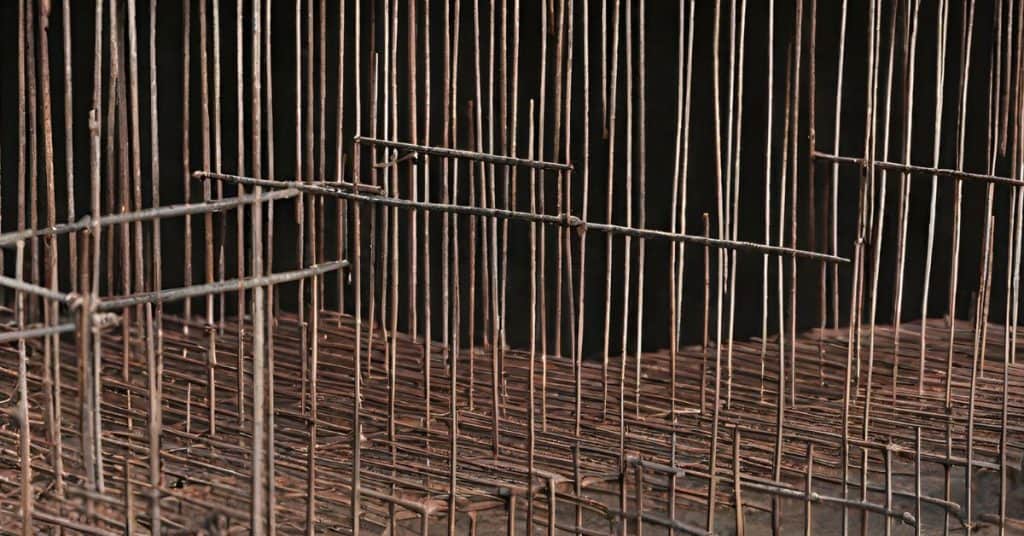
A welded splice joins two bar ends directly using a full-penetration butt weld or, less commonly, a lap weld, creating a continuous steel connection without any mechanical hardware.
How it works:
Per ACI 318, a full-strength welded splice must also meet the same 125% of specified yield strength requirement as a Type 1 mechanical splice. Welding rebar requires weldable-grade steel (typically ASTM A706, since standard A615 rebar isn’t guaranteed weldable without a verified carbon equivalent), AWS D1. 4-certified welders and preheat/procedure controls specific to reinforcing steel.
Advantages:
- Produces a compact, in-line connection with no added bulk from coupler hardware
- Can achieve full-strength performance when executed correctly with qualified welders and proper procedures
- Useful in situations where mechanical hardware won’t physically fit but a lap splice also isn’t feasible
Limitations:
- Requires ASTM A706 weldable rebar (or verified chemistry) welding standard A615 bar without confirming weldability risks brittle, unreliable welds
- Needs certified welders and rigorous quality control, including visual and sometimes non-destructive testing
- Generally the most expensive and schedule-sensitive of the three methods due to certification, procedure qualification, and inspection requirements
- Less common in typical building construction; more frequently seen in specialized structural, industrial, or repair/retrofit applications
Best fit: Specialized structural conditions, repair and retrofit work, and projects where weldable-grade rebar is already specified and certified welding crews are available.
Side-by-Side Comparison
| Factor | Lap Splice | Mechanical Splice | Welded Splice |
| Relative cost | Lowest | Moderate (narrows with bar size) | Highest |
| Max bar size (per ACI 318-19) | #11 | No limit | No limit |
| Space/congestion impact | Highest (needs added length) | Low | Lowest |
| Strength requirement | Bond-dependent (Class A/B) | ≥125% yield strength (Type 1/2) | ≥125% yield strength |
| Special crew/certification | None | Manufacturer training/inspection | AWS D1.4-certified welders |
| Steel type requirement | Standard rebar | Standard rebar | Weldable grade (A706) |
| Common use case | Standard slabs, walls, footings | Mega-columns, large bars, precast joints | Specialized/retrofit conditions |
How to Decide Which Splice to Specify
- Check the bar size first. Anything larger than #11 rules out lap splicing immediately; the decision becomes mechanical vs. welded.
- Look at available space. If a congested column or beam-column joint can’t physically accommodate a full lap length, a coupler is usually the practical answer.
- Consider seismic and high-demand zones. Locations requiring full-strength splices typically call for Type 2 mechanical couplers or qualified welded connections rather than standard lapping.
- Factor in schedule and crew availability. Lap splicing needs no special certification; mechanical splicing needs trained installation and inspection; welded splicing needs certified welders and weldable steel plan procurement and crew scheduling accordingly.
- Run the cost comparison at your actual bar size. The cost gap between lapping and coupling narrows significantly as bar size increases, so what’s “cheaper” on a #5 bar may flip on a #10 or #11 bar.
Conclusion
None of these three methods is universally “better”; each solves a different combination of bar size, congestion, strength, and budget constraints. Lap splicing remains the default for standard reinforcement detailing because it’s simple and economical, but it hits a hard limit at #11 bars and struggles in congested sections. Mechanical splicing earns its place wherever space is tight or bars are too large to lap, with a cost premium that shrinks as bar size grows. Welded splicing stays a specialized tool, reserved for conditions where certified crews and weldable steel are already part of the plan.
Getting this right on paper is one thing; getting it right on a shop drawing that a fabricator can build from without RFIs is another. That’s where accurate rebar detailing, done with the actual congestion, bar sizes, and code requirements of a specific project in mind prevent splice decisions from becoming field problems.
FAQs
Can lap splices be used for all rebar sizes?
No. ACI 318-19 (Section 25.5.1.1) prohibits lap splices for bars larger than #11. Bars #14 and #18 require mechanical or welded splices.
What does “125% of yield strength” mean for a splice?
It’s the ACI 318 threshold (Section 25.5.7 for mechanical splices) that defines a full-strength, Type 1 or Type 2 splice, meaning the connection must be able to develop at least 1.25 times the bar’s specified yield strength before failing, ensuring the splice isn’t the weak point in the reinforcement line.
Is welding rebar always allowed?
Only when the rebar is weldable grade (typically ASTM A706) or its chemical composition has been verified as weldable and the work is performed by AWS D1. 4-certified welders following a qualified procedure. Welding standard A615 bar without verification is not recommended.
Why would a project pay more for mechanical couplers instead of lapping?
In congested sections, large-bar reinforcement, or precast-to-cast-in-place connections, lap splices may not physically fit or may create excessive reinforcement congestion. Mechanical couplers solve that problem, and the cost premium overlap shrinks substantially as bar size increases.