A staircase gets used dozens of times a day, yet most people never think about its design. You notice the floors and walls but the moment someone grabs a railing for balance or a child heads downstairs alone, a good handrail suddenly matters more than anything else in the room.
Good rail detailing is not just about looks. It is about safety, code compliance, structural integrity, and the long-term durability of a building. Whether you are working on a residential home, a commercial office, or an industrial facility, getting the stair handrail detail right from the start saves costly rework and prevents accidents.
This blog covers everything you need to know from the basics of handrail design to the types of detailing services available and why precision matters in every drawing.
Why Handrail Detail Is More Important Than You Think
Most people think a railing is a simple bar on the side of stairs. A proper handrail involves many decisions like choose the material, decide how to mount it and figure out bracket spacing. The height, angle, termination points and where it ends are also important.
Safety Comes First
Building codes in most countries specify minimum height of handrails. It is usually between 34 and 38 inches from the edge of the stairs. It also tells how wide the gaps between the balusters can be and how strong the railing system needs to be. The railing can look really good but if it is not done properly it can still fail a safety check.
It Affects the Whole Project
A missing or incorrect handrail detail can hold up an entire construction project. Fabricators cannot cut and weld without precise dimensions. Installers cannot work without knowing bracket locations and fixing types. Getting the detail right upstream keeps everyone downstream on schedule.
What Is a Stair Handrail Detail?
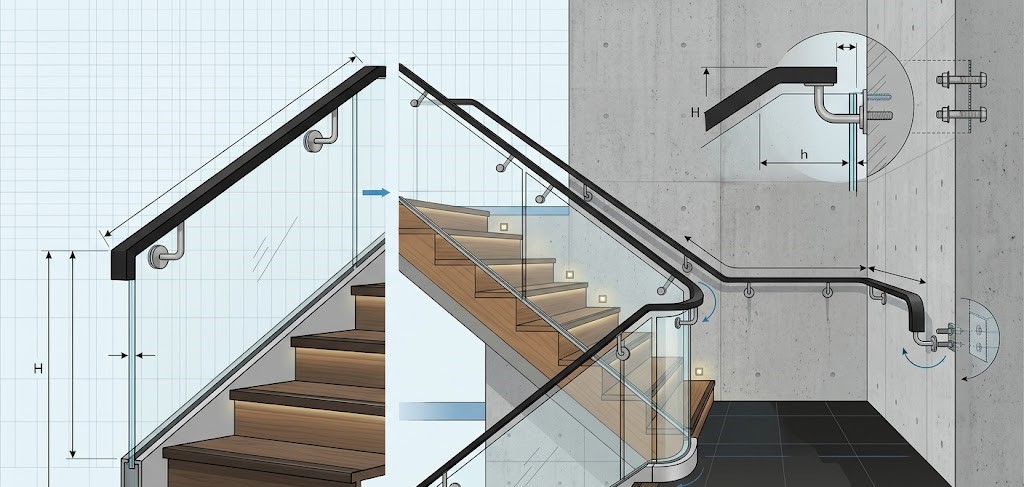
A stair handrail detail is a technical drawing that shows exactly how the railing system is built and connected. It goes beyond a simple elevation sketch; it includes dimensions, materials, weld specifications, bracket types, fixing methods, and finish requirements.
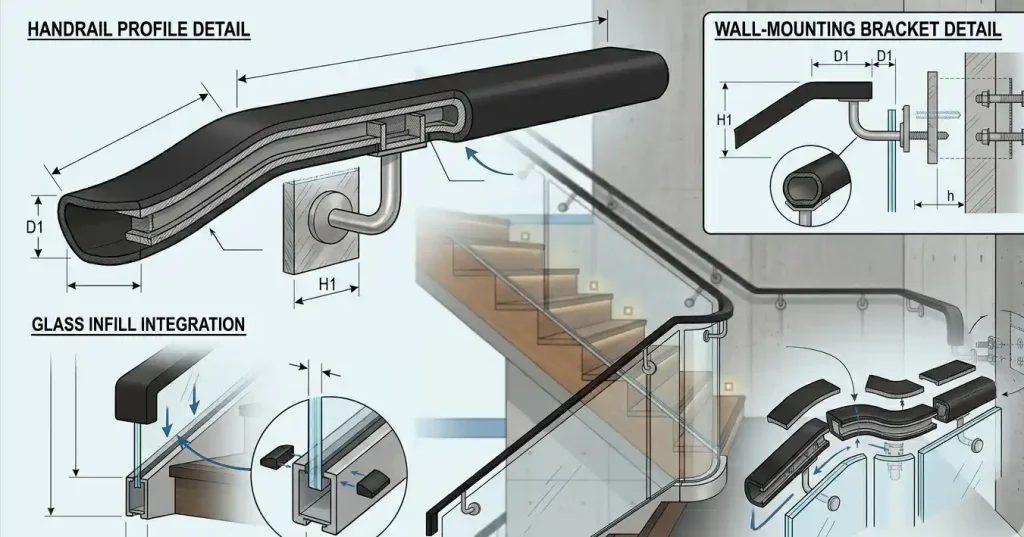
What a Good Stair Handrail Detail Includes
A complete stair handrail detail drawing will typically show:
Plan View: The view, from the top shows how the railing is laid out, post spacing and how it all relates to the stairs.
Elevation View: The side view shows the handrail height. It also shows the angle of the rake. The rail runs parallel to the stair pitch in this view.
Section / Connection Details: Close-up drawings of how the rail is attached to the post, how the post is fixed to the floor or stringer and how the corners or turns are handled with the rail and post.
Material Callouts: Specification of tube size and wall thickness is also important. Material grade includes (mild steel, stainless, aluminum). The finish can vary (painted, galvanized, powder-coated.
Weld Symbols: For fabricators, weld type, size, and location are all marked clearly on the drawing.
Without all of these elements, a fabricator is left guessing and guessing leads to expensive mistakes on the shop floor.
Rail Detail: The Key Components
Whether you are looking at a simple straight run or a complex curved staircase, the same core components appear in every rail detail.
Top Rail
The top rail is what people actually grip. Its profile round, oval, rectangular affects both comfort and code compliance. Round profiles between 1.25 and 2 inches in diameter are the most common for graspability.
Posts and Balusters
Posts are the vertical structural members that anchor the railing to the floor, landing, or stair stringer. Balusters (also called pickets or infill) fill the space between posts. The spacing between balusters is typically limited to 4 inches maximum to prevent a small child from passing through.
Bottom Rail
Some railing systems do not have a rail. When a railing system does have a bottom rail the bottom rail ties the balusters together at the base. It also adds rigidity to the railing system.
Brackets and Fixings
Wall-mounted handrails use brackets fixed into the wall structure. Freestanding systems use base plates welded or bolted to the floor. The fixing method is a critical part of the rail detail. It determines how much load the system can actually handle.
Returns and Terminations
When a handrail ends at a wall it needs a post or a horizontal return. These parts have to be detailed. Open-ended rails can catch clothing or cause injury. Proper terminations are a code requirement in most jurisdictions.
Types of Rail Detailing Solutions
Modern rail detailing solutions cover a wide range of staircase types and design styles. Each has its own technical requirements and detailing complexity.
Straight Stair Handrail Detailing
The common type of railing is a straight run that goes along with the stair pitch. The angle of the railing also known as the rake angle has to be the same as the stair pitch. When the railing goes from the angled part to a flat landing it has to be done in a way that looks good.
Spiral Stair Handrail Detailing
Spiral staircases are one of the most challenging detailing jobs in the industry. Every single part like the brackets and the balusters are at a slightly different angle. Make a detailed computer model of the Spiral staircases to get it right. This is because Spiral staircases have a lot of shapes. You cannot just draw staircases by hand and expect them to be accurate enough to build.
Glass Stair Handrail Detailing
Glass infill railings are increasingly popular in modern architecture for their clean, open look. The detailing for glass systems involves specifying glass thickness and type (typically laminated safety glass), channel or clamp fixing systems, and sealant requirements. The structural calculations behind glass railings are more complex than steel picket systems.
Deck Stair Handrail Detailing
Outdoor deck railings face additional challenges: weathering, moisture, UV exposure, and thermal expansion. Material selection (galvanized steel, aluminum, stainless, composite) and fixing details that prevent water ingress are critical parts of the handrail detail for deck applications.
How to Design a Stair Railing: Step by Step
Knowing about the design process helps clients communicate clearly with detailers and fabricators and helps everyone avoid surprises.
Step 1: Confirm Code Requirements
Before you start drawing make sure to check the building code that applies. The rules for height space between balusters, how easy it’s to grip and how much weight it can hold are different, for each country, state and type of building. A lot of people make the mistake of designing the railing and then checking the codes, which can be very costly.
Step 2: Select Your Material and Style
Use steel, stainless steel, aluminum, wrought iron and glass. Each of these materials is different from the others. Steel is different, stainless steel is different, aluminum is different, wrought iron is different and glass is different. They all have properties that can affect how strong something is. The prices of all these are also not the same.
Step 3: Produce the Handrail Detail Drawings
This is where professional rail detailing solutions come in. A skilled detailer will produce a full set of drawings from your design intent. This set of drawings includes views from the top, from the side and detailed views of the parts that are cut and connected together. The fabricator then uses these drawings to cut, bend and weld the metal into the shape.
Step 4: Fabrication and Review
When the stair handrail detail drawings are finished, the people who make the railings create their drawings. These drawings show how they plan to build the stair handrail. The stair handrail drawings are then checked to make sure they match what the original designers had in mind for the stair handrail. This checking is done before they actually start making the stair handrail.
Step 5: Installation
With accurate detailing, installation is straightforward. Bracket locations are pre-marked, fixing types are specified, and the fabricated sections arrive on site ready to go together. Poor detailing at the design stage almost always results in site modifications which cost time and money.
Common Mistakes in Handrail Detailing
Even experienced teams make detailing errors. Knowing the most common ones helps avoid them.
Some common mistakes everyone should avoid:
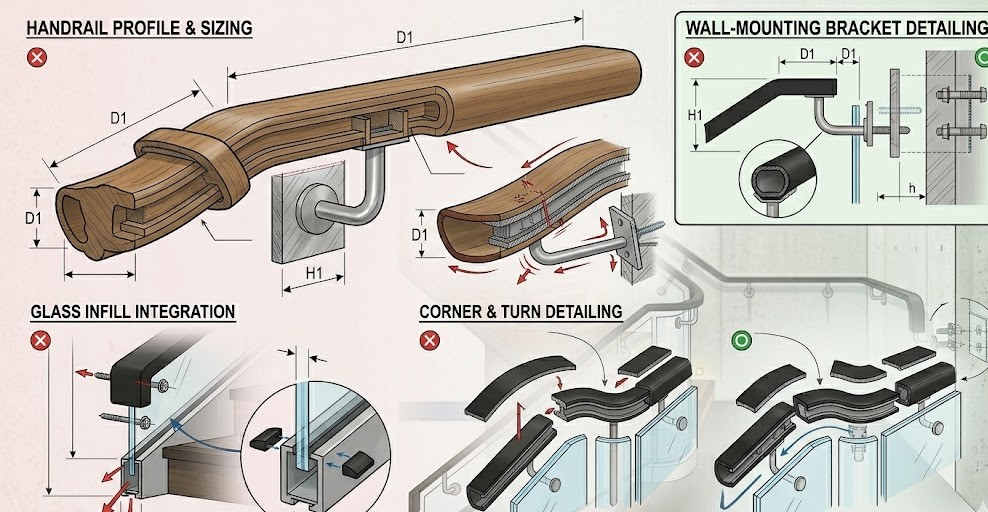
Ignoring the stair pitch
The handrail rake must match the actual stair angle. If the stair pitch is measured incorrectly, the fabricated rail will not fit.
Missing transition details
The junction between a raked rail and a level landing rail is often left undetailed, creating confusion for the fabricator.
Under-specifying fixings
The type and size of anchor bolts or base plates is often left vague. This is a structural issue, not just a drawing issue.
Forgetting about clearances
The handrail must maintain a minimum clearance from the wall (typically 1.5 inches) so a hand can slide along it freely. This affects bracket projection, which must be shown in the detail.
No finish specification
Leaving the finish undefined leads to disputes between client and contractor about what was expected.
Why Professional Rail Detailing Solutions Matter
For simple residential railings, a competent contractor can sometimes work from basic sketches. For anything more complex commercial buildings, spiral stairs, glass systems, multi-story structures, professional rail detailing solutions are not optional, they are essential.
Professional detailers use CAD and BIM software to produce precise, fabrication-ready drawings, catching errors on screen that would otherwise be discovered, expensively, on site.
Services like Steel Construction Detailing deliver complete, fabrication-ready stair handrail detail packages covering spiral, glass, deck, and DNA stair systems from any input format, all to international codes and client specifications.
Final Thoughts
A handrail is the last thing most people think about and the first thing they reach for when they need it most. Investing in proper handrail detail and professional rail detailing solutions ensures that your staircase is not only visually impressive but structurally sound, code-compliant, and built to last.
Whether you are an architect, a contractor, or a building owner, working with experienced detailers who understand both the engineering and the aesthetics of stair railing design will always deliver a better result and a safer building for everyone who uses it.
FAQ’s
Q1. What is a stair handrail detail?
A stair handrail detail is a technical drawing that shows exactly how a railing system is built and connected including dimensions, materials, bracket types, weld specifications, and fixing methods.
Q2. What is the standard height for a stair handrail?
Most building codes require handrail heights between 34 and 38 inches measured from the stair nosing. Requirements can vary by country, state, and building type, so always check your local code before designing.
Q3. How far apart should balusters be spaced?
Balusters should be spaced no more than 4 inches apart. This prevents a small child from passing through or getting stuck between them, a requirement enforced by building codes in most jurisdictions.
Q4. What materials are commonly used for stair handrails?
The most common materials are mild steel, stainless steel, aluminum, wrought iron, and glass. Each has different structural properties, finishing requirements, and price points depending on the project.
Q5. What is the most difficult type of handrail to detail?
Spiral stair handrails are the most complex. The rail follows a helical path where every bracket and connection point sits at a slightly different angle, making precise CAD or 3D modeling essential for accurate fabrication.
Q6. What are the most common handrail detailing mistakes?
The most frequent mistakes include ignoring the stair pitch, missing transition details between raked and level sections, under-specifying fixings, forgetting wall clearances, and leaving the finish undefined on drawings.
Q7. When should I hire a professional for handrail detailing?
For anything beyond a simple residential railing, such as commercial buildings, spiral staircases, glass systems, or multi-story structures, professional rail detailing is essential, not optional.